If you love cats but your eyes start watering the moment one walks in the room, you’re not alone. Millions of Americans live with cat allergies — and most of them still wish they could have a cat. The good news? You might actually be able to.
That’s exactly what this guide is for. You’ll learn what cat breeds are hypoallergenic, why some cats bother your allergies far less than others, and which breed fits your lifestyle, space, and sensitivity level. Let’s get into it.
What Does ‘Hypoallergenic’ Really Mean?
Let’s clear this up right away. ‘Hypoallergenic’ doesn’t mean allergy-proof. The word literally means ‘below normal’ in allergen production. So when people ask what cat breeds are hypoallergenic, they’re really asking: which cats produce fewer allergens than average?
No cat breed is 100% free of allergens. But certain low allergen cats produce significantly less of the main trigger protein than the typical house cat. For many allergy sufferers — especially those with mild to moderate sensitivities — this difference is enough to make comfortable coexistence with a cat genuinely possible.
What Causes Cat Allergies? (The Fel d 1 Protein Explained)
Here’s the real culprit: a tiny protein called Fel d 1. Most people assume cat hair is the problem. That’s actually a widespread misconception. The true trigger is this specific protein, which cats produce naturally in their:
• Saliva
• Skin (sebaceous glands)
• Urine
• Anal glands
When a cat grooms itself, saliva gets deposited all over its fur. As that saliva dries, it breaks into microscopic airborne particles — what we call cat dander. That dander floats through your home and lands in your airways, triggering a cat dander allergy response.
Here’s something important most people don’t realize: male cats produce significantly more Fel d 1 than females. Unneutered males produce the most of all. So even within the same breed, the sex and reproductive status of a cat can meaningfully affect your allergic response.
Key takeaway: Low allergen cats aren’t fur-free or saliva-free. They just naturally produce less of the Fel d 1 protein — the actual trigger. That’s the entire basis of calling a cat ‘hypoallergenic.’
Symptoms of Cat Allergies in Humans
Before diving deeper into what cat breeds are hypoallergenic, it helps to know exactly what you’re dealing with. Cat allergy symptoms range from mild to severe:
| Mild Symptoms | Severe Symptoms |
| Sneezing and runny nose | Asthma attacks |
| Itchy, watery eyes | Chest tightness or wheezing |
| Skin rash or hives | Difficulty breathing |
| Itchy throat | Chronic sinus infections |
| Nasal congestion | Swollen, puffy face |
If your symptoms are on the severe end — asthma attacks, chronic sinus issues, difficulty breathing — talk to an allergist before adopting any cat. A skin-prick test or blood panel gives you a precise sensitivity level and guides which breeds are actually realistic for you.
RELATED ON FIZZPAW
-> Why Are My Cat’s Eyes Watery and Sneezing? Causes, Remedies & Vet Advice — If you’re already experiencing these symptoms, this guide covers causes and solutions
-> How Can I Soothe My Cat’s Itchy Skin? Causes, Remedies & Vet Advice — Covers the overlap between feline skin issues and human allergy triggers
Do Hypoallergenic Cats Really Exist?
Vet Insight
“While no cat breed is completely hypoallergenic, breeds that produce lower levels of Fel d 1 may be significantly easier for allergy sufferers to tolerate. Individual reactions vary greatly depending on personal sensitivity and the specific animal.” — Veterinary consensus, supported by peer-reviewed allergy research
The Scientific Reality
Strictly speaking: no cat is 100% allergen-free. But that doesn’t mean all cats affect you equally. Research has consistently confirmed that specific breeds produce measurably lower quantities of Fel d 1 — and that this difference is clinically significant.
A study published in the Journal of Allergy and Clinical Immunology found that Fel d 1 levels vary by as much as a factor of ten between individual cats. That’s the difference between a cat that sends you to the medicine cabinet and one you barely notice.
Why No Cat Is Completely Allergy-Free
Fel d 1 is a biological function — not a trait that can be bred out entirely. It plays a role in skin protection and may have antimicrobial properties. Every cat produces it. There’s no off switch.
So if someone tells you a specific breed is guaranteed not to cause any reaction, that’s not accurate. What is accurate: some cats are far less likely to trigger symptoms than others — particularly for people with mild to moderate sensitivity.
The Difference Between Low-Allergen and Allergen-Free Cats
Think of it like noise-cancelling headphones vs. earplugs. Earplugs block everything. Noise-cancelling headphones reduce noise dramatically — but don’t eliminate it. Most people find noise-canceling perfectly livable. Same logic applies here.
• Allergen-free cat: Does not exist.
• Low-allergen cat: Produces significantly less Fel d 1. Most mild-to-moderate allergy sufferers can live comfortably with these.
• Standard cat: Average or above-average Fel d 1. More likely to cause persistent symptoms.
Bottom line: Hypoallergenic cats are real in the practical sense — they’re a science-backed strategy, not a myth. But they’re not a guaranteed allergy cure. Think of them as a smart starting point, not the whole solution.
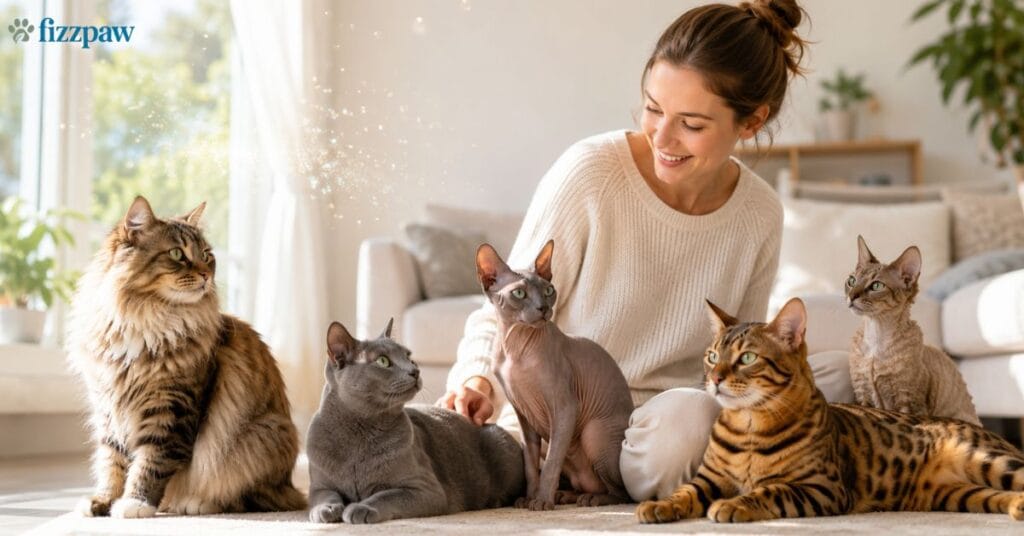
Top 10 Hypoallergenic Cat Breeds for Allergy Sufferers
Here are the best allergy-friendly cats available in 2026. If you’ve been wondering what cat breeds are hypoallergenic and which ones actually deliver on that promise, this is your list:
| Breed | Fel d 1 Level | Coat Type | Best For | Temperament |
| Siberian | Very Low | Long, triple coat | Severe allergy sufferers | Affectionate, playful |
| Balinese | Low | Long, silky, no undercoat | Active families | Vocal, intelligent |
| Bengal | Low | Short, sleek pelt | Active owners | Energetic, curious |
| Devon Rex | Low | Short, wavy curls | Apartments | Playful, social |
| Cornish Rex | Low | Very short, wavy | Low-shedding preference | Energetic, affectionate |
| Sphynx | Low (hairless) | None | Fur sensitivity | Cuddly, social |
| Russian Blue | Low | Short, dense plush | Quieter homes | Gentle, reserved |
| Oriental Shorthair | Low | Short, fine | Interactive owners | Talkative, loyal |
| Javanese | Low | Medium, no undercoat | Families | Smart, devoted |
| LaPerm | Low | Curly, minimal shed | Laid-back households | Calm, gentle |
RELATED ON FIZZPAW
-> Cat Hair Length Chart: A Guide to Short, Medium, and Long Haired Cats — Understand how coat length affects shedding and allergen spread
1. Siberian
Often called the gold standard of hypoallergenic cat breeds, the Siberian produces surprisingly low Fel d 1 despite its lush triple-layered coat. Some research suggests Siberians produce up to 90% less of the protein than average cats. They’re affectionate, playful, and excellent with families.
2. Balinese
Don’t let the long coat mislead you. The Balinese has no undercoat, meaning far less shedding and fewer airborne allergens than its appearance suggests. Essentially a long-haired Siamese — vocal, intelligent, and deeply social.
3. Bengal
Bengals have a unique pelt-like coat that requires minimal grooming and sheds very little. Less self-grooming means less saliva spread — and therefore less Fel d 1 distributed through your home. One of the best low shedding cats for allergy sufferers who want an active, high-energy companion.
4. Devon Rex
The Devon Rex’s short, wavy coat sheds minimally — keeping airborne allergens low. Quirky, playful, and attention-loving, it’s one of the best indoor hypoallergenic cats for apartment living.
5. Cornish Rex
The Cornish Rex has an even finer coat than the Devon Rex, with almost no guard hairs. This dramatically reduces shedding and allergen spread. Fast, affectionate, and almost dog-like in loyalty.
6. Sphynx
The Sphynx is the most recognizable of all non-shedding cat breeds. Hairless by nature, it eliminates the fur that normally carries Fel d 1 through your home. The skin still produces the protein, but regular bathing keeps surface allergens minimal. Great for fur-specific sensitivities.
7. Russian Blue
Russian Blues produce below-average Fel d 1 and tend to stay in one area of the house — limiting how widely allergens spread. Quiet, gentle, and fiercely loyal. A top choice for calmer households.
8. Oriental Shorthair
A fine, short coat with minimal shedding makes the Oriental Shorthair a solid allergy-friendly choice. Talkative and interactive, they bond closely with their owners and thrive on attention.
9. Javanese
The Javanese carries a medium-length coat with no undercoat — low shedding, fewer airborne allergens. Smart and devoted, great for families who want an intelligent, engaged companion.
10. LaPerm
The LaPerm’s curly coat traps loose hair and dander close to the body instead of releasing it into the air. Calm and gentle, ideal for laid-back households and seniors.
Hypoallergenic Cat Breed Comparison Chart
Use this chart to compare the best cats for allergies side by side. It covers the four factors that matter most when choosing an allergy-friendly cat for your home:
| Breed | Allergen Level | Grooming | Shedding | Family Friendly |
| Siberian | Very Low | Medium | Medium | Excellent |
| Russian Blue | Low | Low | Low | Excellent |
| Sphynx | Low | High (baths) | None | Good |
| Bengal | Low | Low | Low | Excellent |
| Devon Rex | Low | Low | Very Low | Excellent |
| Balinese | Low | Medium | Low | Excellent |
| Cornish Rex | Low | Low | Very Low | Good |
| LaPerm | Low | Medium | Low | Good |
Grooming refers to human grooming effort required — not self-grooming. The Sphynx needs weekly baths to remove skin oil buildup (and surface allergens), despite having no fur. Factor this into your decision if you’re short on time.
Best Hypoallergenic Cat Breeds for Different Lifestyles
Knowing what cat breeds are hypoallergenic is the first step. Choosing the right one depends on your specific life. Here’s a breakdown by situation:
Best for Families with Children
• Siberian — patient, sturdy, and genuinely loves kids
• Balinese — playful and gentle; bonds well with children
• Bengal — high energy; perfect for active households
Best for Apartments and Small Spaces
• Devon Rex — compact, quiet, thrives entirely indoors
• Russian Blue — calm and low-maintenance; prefers familiar spaces
• Cornish Rex — energetic but highly adaptable to smaller environments
Best for Seniors
• LaPerm — gentle, calm temperament; easy to manage and groom
• Russian Blue — quiet and loyal; doesn’t demand constant stimulation
• Javanese — affectionate without being hyperactive
Best for First-Time Cat Owners
• Siberian — forgiving, social, and easy to bond with from day one
• Balinese — communicative; tells you exactly what it needs
• Devon Rex — adaptable, low grooming needs, very friendly
Best for Severe Allergy Sufferers
• Siberian — documented lowest Fel d 1 production of any common breed
• Sphynx — no fur means minimal airborne allergen spread
• Russian Blue — low allergen production combined with limited roaming
Even within these categories, individual cats vary. Always spend time with the specific cat — not just the breed — before bringing it home.
RELATED ON FIZZPAW
-> What Cat Breed Is Right for Me? A Complete Personality & Lifestyle Guide — Takes you deeper into matching breed personality to your lifestyle
-> Best Indoor Cat Breeds: Discover the Perfect House Cats You’ll Love — Ideal follow-up if you’re leaning toward an apartment-friendly breed
Hypoallergenic Cat Breed Cost Guide
Budget is a real factor. Here’s what you can expect to pay for the most popular allergy-friendly cats from reputable US breeders:
| Breed | Typical Price (USD) | Notes |
| Siberian | $1,000 – $2,500 | Most popular; widely available from breeders |
| Bengal | $1,500 – $3,000 | Higher due to exotic lineage |
| Sphynx | $1,500 – $4,000 | Rare; ongoing grooming costs higher |
| Russian Blue | $800 – $2,500 | More affordable; widely bred |
| Devon Rex | $600 – $2,000 | Great value for allergy sufferers |
| Balinese | $800 – $2,000 | Less common than Siamese |
| Cornish Rex | $600 – $1,500 | Budget-friendly option |
| LaPerm | $500 – $1,500 | Rarer breed; check registered breeders |
These prices reflect purchase cost from registered breeders. Adoption from a rescue is often significantly cheaper, sometimes under $200 — though breed availability varies. Also factor in ongoing costs: vet visits, food, grooming supplies, and allergy management tools like HEPA purifiers.
How to Test Your Reaction Before Adopting
This is the step most articles skip — and one of the most important. Before committing to any cat, test your reaction first. Here’s how to do it properly:
1. Visit a shelter or breeder and spend 30–60 minutes with the specific breed you’re considering.
2. Don’t just wave hello. Pet the cat, let it sit on your lap, and touch your face naturally.
3. Come back a second day. Some allergic reactions build with repeated exposure, not just the first contact.
4. Talk to an allergist beforehand. A skin-prick test or blood panel gives you a precise Fel d 1 sensitivity reading — this shapes which breeds are actually viable for you.
This step can save both you and the cat from a difficult situation. A returned cat is hard on the animal. A prolonged allergic reaction is hard on you. Take the time to test.
Practical Tips for Managing Cat Allergies at Home
Even with the most allergy-friendly cat, home management makes a critical difference. These strategies work best when layered together:
• HEPA air purifier: Captures airborne Fel d 1 particles before they reach your airways. Place one in every room your cat uses most. Studies show this single change can reduce indoor allergen load by up to 70%.
• Bedroom restriction: Keep your cat out of your bedroom entirely. Eight hours of allergen-free sleep significantly reduces your overall daily symptom load.
• HEPA vacuum twice weekly: Allergens embed in carpet, sofas, and curtains. A vacuum with a HEPA filter removes them rather than recirculating them back into the air.
• Wash hands after every petting session: Simple but consistently effective — especially before touching your eyes or face.
• Bathe your cat regularly: A weekly or bi-weekly bath dramatically reduces surface Fel d 1, even on low-shedding cats.
• Replace carpet with hard floors: Allergens get trapped deep in carpet fibers. Hardwood or tile is far easier to keep allergen-free.
• Wash soft furnishings weekly: Use hot water (130 degrees F or above) on bedding, throws, and cushion covers.
RELATED ON FIZZPAW
-> Can I Use Human Shampoo on Cats? Vet-Backed Guide for Safe Cat Grooming — Essential reading before you start bathing your cat to reduce allergens
Can Cat Diet and Grooming Reduce Allergens?
Yes — and it’s one of the most underreported strategies in this space.
Research shows that what a cat eats directly influences how much Fel d 1 it produces and spreads. Purina developed a cat food called Pro Plan LiveClear containing a specific egg product ingredient. When cats eat it, antibodies in the food bind to Fel d 1 in saliva and neutralize it before it can spread. Clinical studies showed an average 47% reduction in active Fel d 1 in cat hair and dander, beginning in the third week of feeding.
Regular grooming by someone other than the allergy sufferer — outdoors or in a well-ventilated area also makes a meaningful difference. It removes loose hair and dried saliva before it can drift through your living space and become airborne.
Power combination: Low allergen breed + allergen-neutralizing diet + HEPA air purifier + bedroom restriction = the most effective approach for most mild-to-moderate allergy sufferers.
RELATED ON FIZZPAW
-> Best Cat Food for Skin Allergies: Causes, Symptoms & Vet-Approved Diet Plans — Vet-approved diet strategies including allergen-reducing food options
Frequently Asked Questions (FAQs)
Q1: Can female cats be more hypoallergenic than male cats?
Yes. Female cats produce less Fel d 1 than males, and spayed females produce the least of all. If allergy severity is a concern, a spayed female from a low-allergen breed — like a Siberian or Russian Blue — is the optimal combination for minimizing your allergic response.
Q2: Are Siberian cats truly hypoallergenic?
Siberians are the closest thing to a genuinely hypoallergenic cat. They still produce some Fel d 1, but their levels are dramatically lower than most breeds — often by 75 to 90%. Many allergy sufferers who react strongly to other cats report minimal or zero symptoms with a Siberian. Individual results vary, so a test visit before adopting is always recommended.
Q3: Can air purifiers help with cat allergies?
Yes — significantly. HEPA air purifiers capture airborne Fel d 1 particles before they reach your airways. Running one in rooms your cat uses most can reduce indoor allergen load by up to 70%. They work best as part of a broader strategy, not as a standalone fix.
Q4: Is a Sphynx cat good for allergy sufferers?
The Sphynx is a solid choice for people whose allergies are triggered primarily by cat fur. Since it has no coat to carry and spread Fel d 1, less allergen becomes airborne. Sphynxes still produce the protein through skin oils, so regular weekly bathing is essential. Best suited for people whose sensitivities are fur-related more than saliva-related.
Q5: What is the best hypoallergenic cat for first-time owners?
The Siberian is the top recommendation for first-time owners with allergies. It’s social, easy to bond with, adapts well to family life, and produces the lowest Fel d 1 of any common breed. The Balinese is a close second, communicative and forgiving for new owners navigating their first cat.
Final Thoughts
Living with cat allergies doesn’t have to mean giving up on a feline companion. Now that you know what cat breeds are hypoallergenic — and why they affect your body differently — you’re in a much better position to make a smart, lasting choice.
Start with the Siberian or Russian Blue if allergies are your primary concern. Visit before you commit. Build a home management strategy. And consider a Fel d 1-reducing diet to cut your exposure at the source.
With the right approach, millions of allergy sufferers live comfortably alongside their cats every day. You might be surprised at just how possible it really is.