If your cat has been looking a little rounder lately, you’re not alone. Cat obesity is one of the most common health problems that vets see today. The good news? You can help your cat lose weight — safely, gradually, and without making your furry friend miserable.
This guide gives you a complete, vet-approved cat weight loss plan. We’ll cover why cats gain weight, how to check if yours is overweight, what to feed them, how to get them moving, and how long it’ll take to see real results. Let’s get started.
Why Your Cat Is Gaining Weight (Hidden Causes Most Owners Miss)
Most cat owners assume weight gain is simple — too much food, not enough exercise. But there’s often more going on beneath the surface. Here are the real reasons your cat might be packing on the pounds.
Overfeeding without measuring food is probably the number one culprit. A lot of people eyeball their cat’s portions, which almost always leads to overfeeding. Even a tiny daily surplus adds up fast.
Free-feeding dry food habits make things worse. When a bowl of kibble is always available, many cats just snack all day. Dry food is also calorie-dense, so it’s easy for cats to consume way more than they need.
Lack of indoor activity is another big factor. Indoor cats don’t hunt, climb trees, or roam large territories. They sleep most of the day, and that means fewer calories burned.
Neutering-related metabolism slowdown catches many owners off guard. After spaying or neutering, your cat’s metabolism naturally slows down — sometimes by as much as 20–30%. If you don’t adjust their food intake afterward, weight gain follows.
Human food and treat overuse adds hidden calories that owners often forget to count. A small piece of chicken here, a few treat pieces there — it adds up quickly. Curious whether specific foods are safe? Check out our guide on can cats have peanut butter — risks, safety, and healthy alternatives before sharing snacks.
Stress eating and boredom are real behavioral issues in cats. A bored or anxious cat may eat more than it needs, especially if food is always available.
Why Helping Your Cat Lose Weight Is So Important for Long-Term Health
Extra weight isn’t just a cosmetic issue. For cats, obesity is a serious medical condition that can shorten their life and reduce their quality of life significantly. According to VCA Animal Hospitals, helping your cat lose weight can add meaningful years to their life — and make those years much more enjoyable.
Diabetes risk is one of the biggest concerns. Overweight cats are up to four times more likely to develop type 2 diabetes than cats at a healthy weight. In fact, feline diabetes closely mirrors type 2 diabetes in humans — and it’s largely preventable through weight management.
Arthritis and joint pain become common as extra pounds put constant stress on your cat’s joints. You might notice your cat moving more slowly, hesitating to jump, or spending more time lying around. Pay attention to your cat’s body language — even subtle tail movements can signal discomfort. Our article on what your cat’s tail is telling you can help you read those signs.
Heart and liver disease risks also rise with obesity. Fat deposits can accumulate around the heart, and the liver can become overworked — especially if your cat goes through rapid, unsafe weight loss (more on that later).
Reduced lifespan and low energy are well-documented outcomes of feline obesity. Overweight cats simply don’t live as long, and they’re often lethargic and less playful even while they’re alive.
Grooming and hygiene problems sneak up on many cat owners. When a cat is overweight, it can’t reach certain parts of its body to groom properly. This leads to matted fur, skin irritation, and hygiene issues that cause real discomfort.
How to Check If Your Cat Is Overweight (Body Condition Score Guide)
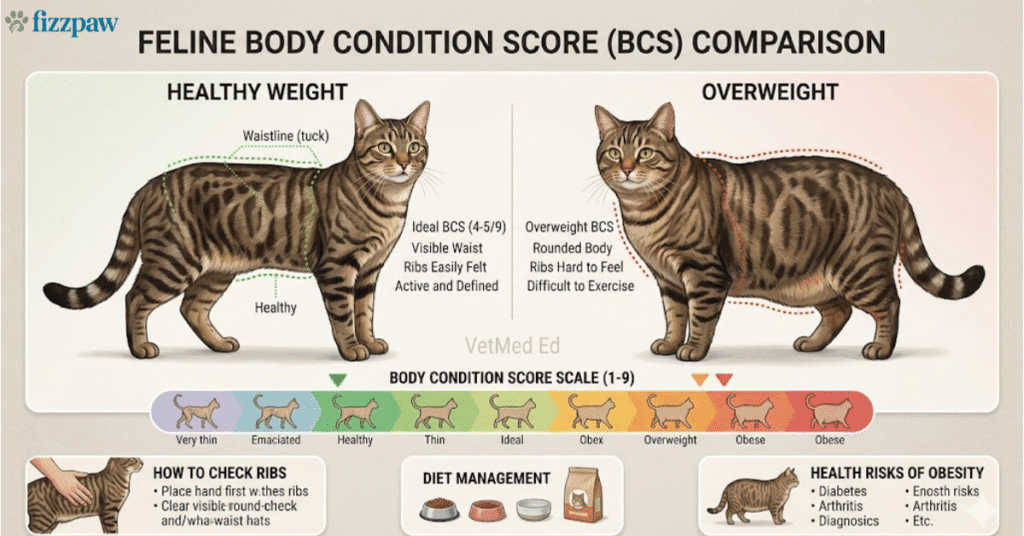
Before you start any cat weight loss plan, you need to know where your cat stands right now. Here’s how to do a quick at-home assessment. The Cornell Feline Health Center recommends a simple three-point check you can do at home.
Rib Check Method (Touch Test)
Run your hands along both sides of your cat’s rib cage. You should be able to feel individual ribs without pressing hard. If you can’t feel them at all, or you have to press firmly, your cat is likely overweight.
Waist Visibility Test (Top View)
Look down at your cat from above. You should see a slight “hourglass” shape — a visible narrowing between the ribcage and hips. If your cat looks more like a rectangle or oval from above, that’s a warning sign.
Belly Tuck Test (Side View)
Look at your cat from the side. There should be a slight upward tuck behind the belly as it approaches the hind legs. A belly that hangs low or appears rounded is a sign of excess weight.
BCS Scale Explanation (1–9 System)
Vets use a Body Condition Score (BCS) system to evaluate cats:
| BCS Score | What It Means |
| 1–2 | Underweight or emaciated |
| 3–4 | Lean to ideal |
| 5 | Ideal weight |
| 6–7 | Overweight |
| 8–9 | Obese |
A score of 5 is perfect. If your cat scores 6 or higher, it’s time to act. Your vet can assign an official BCS score during a checkup.
Ideal Weight vs Overweight vs Obese
Most domestic cats have an ideal weight of 8–10 pounds, though this varies by breed and sex. According to Chewy’s veterinary team, including Dr. Carly Fox, DVM, of Schwarzman Animal Medical Center, male cats generally weigh more than females. Rather than relying on a number on the scale alone, the BCS system gives a more accurate picture of your individual cat’s health.
Step-by-Step Plan to Help Your Cat Lose Weight Safely
Ready to help your cat slim down? Follow these steps in order — don’t skip ahead.
Vet Consultation and Health Screening
Always start here. Before changing your cat’s diet, see your vet. Weight gain can sometimes signal underlying health issues like hypothyroidism or other hormonal problems. Your vet will rule these out and help you build a safe plan. As PetMD emphasizes, any cat weight loss plan should be a true collaboration between you and your veterinarian.
Setting Ideal Target Weight
Your vet will help you determine a healthy goal weight based on your cat’s breed, size, and BCS score. Don’t set arbitrary goals — this needs to be individualized.
Calculating Daily Calorie Needs
Vets use a formula called the Resting Energy Requirement (RER) to calculate how many calories your cat needs. The formula is:
RER = 70 × (ideal body weight in kg)^0.75
From there, a weight-loss multiplier is applied. Your vet will do this math for you and give you a daily calorie target.
Starting a Slow Calorie Reduction Plan
Don’t cut calories sharply all at once. A gradual reduction — usually to about 80% of your cat’s RER — is the safest approach. Sudden food restriction can actually make cats very sick.
Weekly Adjustment System
Weigh your cat every week and track the results. If your cat is losing weight faster than expected, increase calories slightly. If there’s no progress after a few weeks, consult your vet about adjusting the plan.
Safe Weight Loss Rate (0.5–1% Per Week)
This is the golden rule. According to the Purina Institute’s weight management guidelines, cats should lose no more than 0.5–1% of their body weight per week to maintain lean muscle mass and prevent metabolic complications. For a 15-pound cat, that’s roughly 1–1.5 ounces per week. Slow and steady really does win this race.
Best Cat Feeding Strategy for Weight Loss (What Actually Works)
Diet is about 90% of the battle when it comes to helping your cat lose weight. Here’s what the research and vets actually recommend.

Wet Food vs Dry Food Comparison
| Feature | Wet Food | Dry Food |
| Water content | 70–80% | 6–10% |
| Calories per serving | Lower | Higher |
| Satiety | Higher | Lower |
| Convenience | Less | More |
| Weight loss suitability | Better | Okay with portion control |
Wet food is generally better for weight loss because it’s more filling and lower in calories per ounce. It also keeps cats hydrated, which supports kidney health. Wondering about other food questions? Our guide on can cats eat yogurt covers another common dietary question with full vet-approved detail.
High-Protein, Low-Carb Diet Benefits
Cats are obligate carnivores. Their bodies are built to run on protein and fat — not carbohydrates. A high-protein, low-carb diet mimics their natural prey-based diet, keeps them feeling full longer, and helps preserve lean muscle mass during weight loss.
Meal Feeding vs Free Feeding
Switch from free feeding (leaving food out all day) to scheduled meals. Feed your cat 2–4 small meals daily at set times. This gives you control over exactly how much your cat eats — and it also gives your cat something to look forward to.
Portion Control Using a Gram Scale (Not Cups)
This one is a game-changer. Measuring by cups is inaccurate because kibble density varies. Use a kitchen gram scale to weigh every meal. This ensures you’re hitting your cat’s calorie target precisely, not roughly.
Feeding Schedule (2–4 Small Meals Daily)
Splitting the daily food allowance into smaller, more frequent meals keeps your cat satisfied and reduces begging. Automatic feeders can make this routine effortless.
Common Cat Weight Loss Mistakes You Must Avoid
Even with the best intentions, owners often make mistakes that slow progress — or worse, harm their cat.
Starving or extreme calorie cuts is the biggest danger. Cutting food too drastically doesn’t just cause hunger — it can trigger a life-threatening condition called hepatic lipidosis (fatty liver disease). Never reduce your cat’s food by more than 20–25% at a time without vet guidance.
Rapid weight loss danger deserves its own emphasis. If your cat loses more than 2% of its body weight per week, contact your vet immediately and increase calories. The Association for Pet Obesity Prevention (APOP) warns that cats who stop eating entirely are at immediate risk — fatty liver disease can develop within just 24–48 hours of food refusal.
Over-treating or hidden calories quietly sabotage weight loss plans. A single commercial cat treat can contain 3–10 calories. If you’re giving 10 treats a day, that’s potentially 100 extra calories — which can offset an entire day’s calorie reduction.
Inconsistent feeding schedule confuses your cat and makes the plan harder to follow. Stick to the same times every day, even on weekends.
Switching diets without guidance can cause digestive upset. Any new food should be introduced gradually over 7–10 days, mixing increasing amounts of the new food with the old.
How to Increase Your Cat’s Exercise and Burn Fat Naturally
Exercise won’t replace a good diet, but it helps — and it improves your cat’s mood, mental health, and muscle tone.
Daily 10–15 minute play sessions are the foundation. Use a wand toy, feather teaser, or laser pointer to get your cat running, pouncing, and leaping. Even short bursts of activity make a real difference over time.
Hunting simulation games tap into your cat’s natural instincts. Move a toy across the floor erratically, hide it under a blanket, or let it “escape” around corners. This kind of play is genuinely exciting for cats. Understanding your cat’s natural behaviors makes playtime more effective — take a look at why cats bite and then lick to better understand how they communicate during play.
Food puzzle toys and enrichment feeding are brilliant for combining exercise and mealtime. Instead of putting food in a bowl, put it in a puzzle feeder that your cat has to bat, roll, or paw to access. This slows eating and adds physical activity.
Moving food bowls to increase activity is a simple trick. Put the food bowl on a different floor than usual, or across the house from where your cat sleeps. Those extra steps add up.
Rotating toys to prevent boredom keeps things fresh. Cats quickly lose interest in the same toy. Keep a rotation going, and occasionally introduce something new to reignite their enthusiasm.
How to Stop Begging and Food Obsession Behavior in Cats
One of the hardest parts of helping your cat lose weight? The begging. Here’s how to handle it without caving.
Understanding begging psychology is your first tool. Cats beg because it works. If you’ve ever given in to crying or rubbing against your legs, you’ve trained your cat to beg more. Stopping the reward breaks the habit over time.
Scheduled feeding to control habits helps enormously. When cats know food comes at specific times, they stop spending all day pestering you. It usually takes 1–2 weeks for them to adjust to the new routine.
Using automatic feeders removes you from the equation entirely. If food dispenses from a machine, your cat won’t associate food with you — and it’ll stop begging at you directly.
Replacing food rewards with play is a healthy swap. When your cat begs, redirect with a toy or a brief play session. This burns calories instead of adding them.
Managing night-time begging behavior is tough but manageable. Don’t feed your cat in the middle of the night, no matter how loudly they protest. Keep to the morning feeding schedule. Within a week or two, most cats stop the night-time routine if it consistently fails.
Safe Treat Guidelines During Cat Weight Loss
Treats aren’t banned — but they need to be managed carefully.
The 10% calorie rule for treats is the universal veterinary guideline. According to APOP’s weight loss calculator, treats should never account for more than 10% of your cat’s total daily calorie intake. That’s often fewer treats than you’d think.
Low-calorie treat alternatives include small pieces of plain cooked chicken, freeze-dried meat, or plain canned pumpkin (a fiber-rich, low-calorie option many cats enjoy). Always check calorie counts before buying any commercial treat.
Using kibble as treats is a brilliant workaround. If your cat is on a dry food diet, set aside a portion of their daily kibble allowance to use as treats throughout the day. You’re not adding extra calories — you’re just distributing them differently.
Hidden treat calorie risks trip up even careful owners. Some “healthy” or “natural” treats are surprisingly calorie-dense. Always check the label, and count every treat toward the daily total. Also worth noting — certain popular human snacks can be harmful. Our complete guide on can cats eat peanut butter explains exactly which everyday foods to keep away from your cat.
Treat timing and portion control matters too. Don’t give treats right before meals — it can dull appetite and throw off your feeding schedule. Spread treats out across the day in small amounts.
Multi-Cat Household Weight Control System
Managing cat weight loss gets complicated when you have multiple cats. Here’s how to make it work.
Preventing food stealing between cats starts with understanding which cat is which. Some cats eat quickly and then try to steal food from slower eaters. Monitoring mealtimes closely is essential.
Separate feeding rooms or zones are the most reliable solution. Feed each cat in a different room, close the doors during mealtimes, and don’t open them until everyone is done. This ensures each cat gets exactly what it’s supposed to get.
Microchip feeder solutions are a game-changing technology for multi-cat homes. These feeders only open for the cat with the matching microchip. Each cat can access only its own bowl, regardless of what other cats are doing.
Scheduled feeding vs free access — in a multi-cat household, scheduled meals are non-negotiable. Free feeding makes individual portion control impossible.
Monitoring individual cat intake requires consistency. Weigh each cat separately at least once a week. Keep a log. If one cat isn’t losing weight as expected, you can spot it quickly and adjust.
How Long It Takes for a Cat to Lose Weight + Progress Tracking
Be patient — safe cat weight loss is a slow process.
Expected timeline (2–6 months or longer) is realistic for most cats. A cat that needs to lose 3–4 pounds might take 4–6 months to reach its goal weight. Don’t rush it — safe is always better than fast.
Weekly weight monitoring system is the best way to stay on track. Weigh your cat at the same time each week, on the same scale, ideally before feeding. Log the number every time.
Vet check-in schedule should happen at least every 4–6 weeks during active weight loss. Your vet can catch any health issues early and fine-tune the plan if needed.
Home scale vs clinic scale tracking — use both. A baby or pet scale at home works well for weekly monitoring. Your vet’s scale gives you an accurate baseline. If the numbers differ slightly, that’s okay — just be consistent with whichever scale you use at home.
Plateau handling strategy: if your cat’s weight has stalled for 2–3 weeks despite following the plan, don’t panic. Talk to your vet. Common solutions include slightly reducing calories further, increasing activity, or switching to a prescription weight management diet. And if your cat seems sluggish or shows any unusual symptoms during this phase, our article on why cats drool — causes, diagnosis, and treatment can help you identify whether something more is going on.
Final Vet Advice: Keeping Your Cat Fit for Life
Reaching goal weight is fantastic — but keeping it there is the real challenge.
Importance of long-term maintenance diet: once your cat hits its target weight, calorie needs change again. Your vet will calculate a new daily calorie target for weight maintenance, which is typically higher than the weight-loss amount.
Transition from weight loss to maintenance should be gradual. Increase food slowly over 2–4 weeks as you approach goal weight. Jumping straight to maintenance calories can cause rapid regain.
Preventing rebound weight gain requires ongoing vigilance. Keep weighing your cat monthly even after reaching goal weight. If you notice an upward trend, address it early before significant weight returns. Also keep an eye on your cat’s digestive health — issues like constipation can flare up during dietary transitions. Our home remedies for cat constipation guide covers natural, vet-approved solutions if that happens.
Lifestyle changes for permanent health are the foundation. Everything you’ve learned — scheduled meals, portion control, daily play, no free feeding — these aren’t temporary measures. They’re the new normal for a healthy cat.
Building a sustainable routine means making these habits easy to stick to. Automatic feeders, consistent playtime, and regular vet visits remove the friction. When the routine becomes automatic for you, your cat benefits for life.
Frequently Asked Questions
How can I get my indoor cat to lose weight?
You can help an indoor cat lose weight by controlling portions, switching to scheduled feeding, and increasing daily play. Use puzzle feeders, interactive toys, and short play sessions to boost activity while maintaining a controlled calorie intake.
What is the 3-3-3 rule for cats?
The 3-3-3 rule refers to a cat’s adjustment period: 3 days to decompress, 3 weeks to learn routines, and 3 months to fully adapt. While not directly a weight loss rule, it helps reduce stress, which supports healthier eating habits.
How much weight should a cat lose per week?
A safe weight loss rate for cats is 0.5% to 1% of their body weight per week. Faster weight loss increases the risk of serious liver disease, so gradual progress is always safer and recommended by veterinarians.
What can I feed my cat to lose weight?
Feed your cat high-protein, low-carb foods designed for weight management. Wet food is often preferred because it has fewer calories and increases fullness. Always measure portions carefully and follow your vet’s calorie recommendations.